ClarityCare AI Leads HCAA's First Hands-On AI Hackathon Session
From concept and ideation to working prototype in 60 minutes.
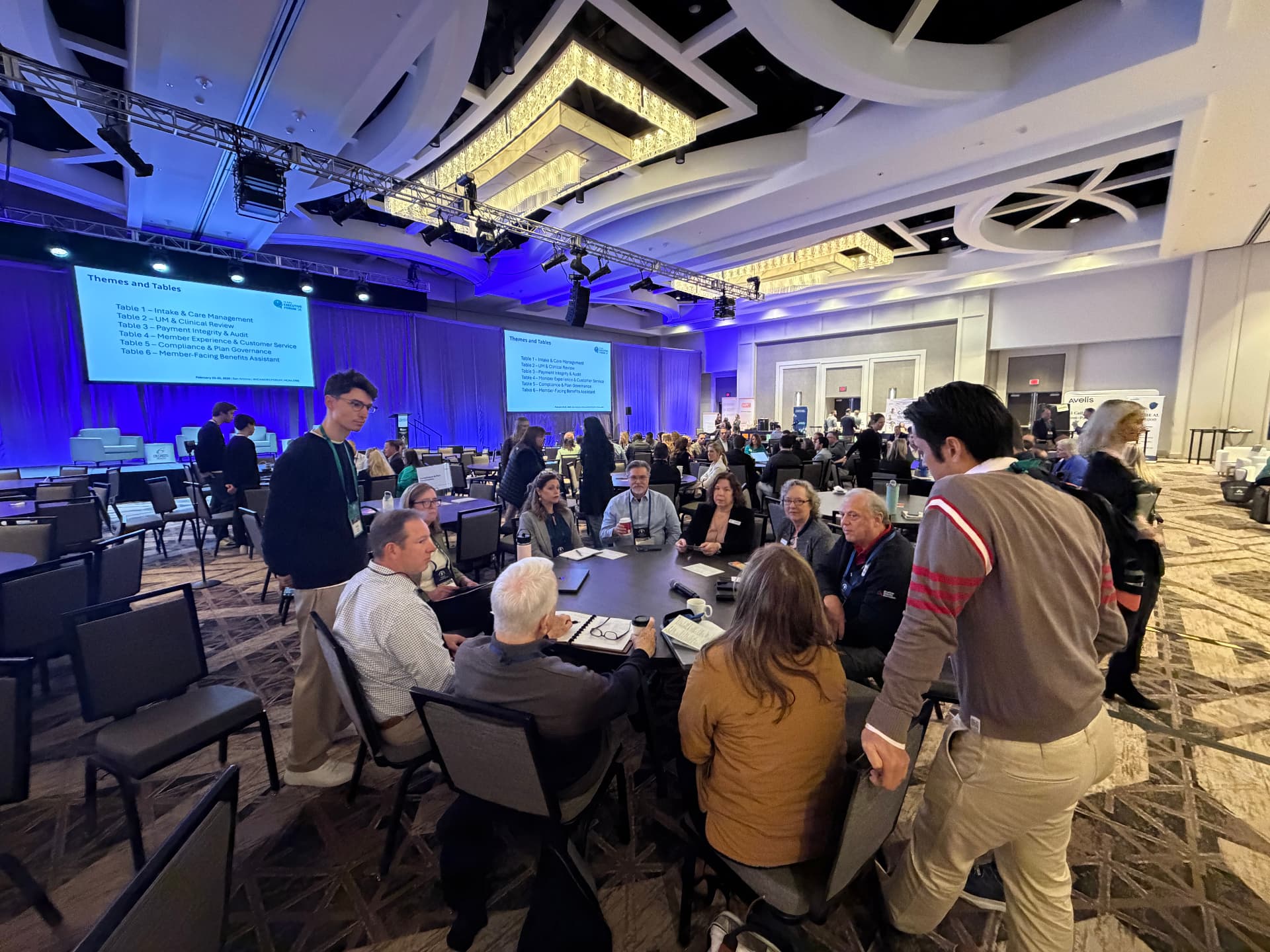
Overview
Conceived and led by ClarityCare AI Co-Founders Hermine Tranie and Alex Andrei, HCAA's first hands-on AI hackathon was designed to help members leverage AI to turn ideas into real, working prototypes.
At a Glance
| Event | HCAA Executive Forum, San Antonio |
| Format | 90-minute hands-on workshop |
| Participants | 157 healthcare executives including leaders from Third-Party Administrators (TPAs), Pharmacy Benefit Managers (PBMs), stop-loss insurers, specialty networks, and other companies serving the self-insured industry |
| Team Structure | 6 teams of 20 to 30 individuals |
| Led by | ClarityCare AI Co-Founders |
| Facilitated by | ClarityCare AI Team |
Format
The session was structured as a 90-minute, three-part workshop:
1) Introduction & Framing (10 min)
Facilitators set the stage by outlining the operational challenges in the self-funded space and orienting participants to the AI tools they would be using.
2) Build Time (60 min)
Within minutes, 20 to 30 participants gathered around one of six tables. Each table represented a distinct self-funding administrative area, namely:
1. Intake & Care Management
2. Member Experience & Customer Service
3. Compliance & Governance
4. Utilization Management & Clinical Review
5. Payment Integrity & Audit
6. Member-Facing Benefits Assistant
Within each table, participants were presented with a real operational challenge from their team's assigned area. They brainstormed solutions and aligned on one direction as a group. From there, they got to work building their product with AI.
3) Share-Out & Debrief (20 min)
Leaders from each table presented their problem and pitched their solution, with a live platform demo where applicable.
What They Built
Each group identified the single most meaningful goal for their topic, then worked with AI tools in real time to build toward it. Prototypes were built using simulated data. Some examples include:
Prior Authorization & Intake AI
An intake workflow that triages prior authorization requests, flags missing clinical information, and routes cases, freeing staff to focus on decisions that require human judgment.
Real-Time Patient Intelligence
An AI layer that generates a live, plain-language summary of a patient's care situation, surfaced directly to the patient in real time. This directly addresses one of the most consistent frustrations in the space: opacity.
Member-Facing Benefits Assistant
A prototype that lets patients ask plain-language questions about their plan benefits, with an immediate hand-off to a live person when needed. During the demo, the phone actually rang, connecting to someone in the audience.
Key Learnings
1. Building with AI Is Fast. Production Is Where the Complexity Lives.
The hackathon demonstrated real 0-to-1 capability: teams built impressive, functional prototypes in under an hour. But the session also revealed the gap between a prototype and a production-ready solution. The path to productionalization requires integration, validation, and governance before operating in a live environment. The most valuable realization wasn't what AI could build fast, but rather understanding what comes next.
2. The SPD Is the Foundation
A clear pattern emerged across every table: the SPD, or the Summary Plan Document, is the foundational business contract of the self-funded space. It governs the employer-TPA relationship, defines coverage and claim adjudication rules, shapes member communications, and sets the operational rules for claim systems and medical management. Any AI solution built in this space, whether for intake, compliance, member experience, or payment integrity, must account for the SPD at its core.
3. Cross-Functional Diversity Accelerates Insight
CEOs, COOs, compliance leads, clinical directors, sales executives, and benefits consultants all brought different perspectives to the same problem. That mix generated productive discussion and surfaced insights a more homogeneous group simply wouldn't have found.
"The biggest challenge was integrating the different viewpoints. But what was inspiring was that everyone aligned around the same push regarding visibility and patient priority. That's a strong foundation to build on."
- Simon Lefort, ClarityCare AI
Outcomes & Next Steps
The hackathon was a proof of concept, not just for the applications built, but for a model of engagement that can move this industry forward. AI tools are accessible, the use cases are clear, and the operational expertise to deploy them thoughtfully already exists within this community.
What surfaced in that room is actively informing how ClarityCare AI is evolving its products and use cases, and the session has already opened doors to continued collaboration.
"I am inviting Hermine and her team to Chicago to collaborate with PBA's IT staff to explore how internal development cycles could be accelerated using AI tools such as Claude."
- Jeff Walter
We're grateful for every perspective brought to those tables and excited to keep building with this community in the months ahead.